Why Is Your Website Getting Attacked (and Hacked) More in 2026
If you own or manage a website, you may have noticed something unsettling over the past year or two: more blocked login attempts, suspicious traffic, vulnerability alerts, malicious bots, and, in some cases, actual website compromises.
It can feel like someone suddenly decided to target your business. In most cases, that is not what is happening.

The web security environment has changed. Attackers have better automation, better tools, and increasingly powerful artificial intelligence at their disposal. At the same time, modern websites have become more complicated and increasingly dependent on plugins, extensions, third-party services, APIs, and other software.
The result is simple: attackers can find and exploit vulnerable websites faster than ever before.
Table of Contents
- AI Has Changed Website Hacking
- Your Small Business Website Probably Isn’t Being Personally Targeted
- Known Website Vulnerabilities Are Being Exploited Exceptionally Quickly
- There Are More Vulnerabilities to Find
- Being Fully Updated Doesn’t Necessarily Mean You Aren’t Vulnerable
- Websites Accumulate Security Risk Over Time
- Hosting Security and Website Security Are Not the Same Thing
- Your Original Web Designer May Not Be Maintaining Your Website Either
- Website Security in 2026 Requires Ongoing Expertise
- Need a Recommendation for a Qualified Developer Who Offers Web Security?
AI Has Changed Website Hacking
Artificial intelligence is not solely responsible for the increase in website attacks, but it is accelerating trends that were already happening.
Hackers are Leveraging AI Tools to Identify and Attack Vulnerabilities
AI tools can help bad actors analyze code, research vulnerabilities, generate or modify scripts, troubleshoot attack methods, and process large amounts of technical information faster. Tasks that once required significant expertise and manual effort can increasingly be assisted by AI.

Verizon’s 2026 Data Breach Investigations Report (DBIR) found that exploitation of software vulnerabilities was the initial access method in 31% of breaches, surpassing stolen credentials for the first time in the report’s 19-year history. Verizon specifically noted that AI is helping threat actors reduce the time between identifying vulnerabilities and exploiting them from months to hours.
Google’s Mandiant reported a similar trend in its M-Trends 2026 report. Exploits remained the most common initial infection vector for the sixth consecutive year, accounting for 32% of the intrusions Mandiant investigated during 2025.
Plugin and Extension Developers Are Using AI for Security Testing
Of course, AI works both ways. Security researchers, developers, and security professionals can use AI to review code, identify suspicious behavior, analyze vulnerabilities, and strengthen security. We’ve seen numerous cases where developers are using AI to make their software more secure (known as security hardening).
AI Developed Code Poses Some Risk As Well
There is also another side to AI: AI-generated code. Amateur developers and website owners are increasingly using AI to create custom code, integrations, scripts, plugins, and modifications. That can increase productivity, but AI-generated code should never automatically be assumed to be secure.
Poorly reviewed AI code can introduce vulnerabilities just as poorly written human code can.
Your Small Business Website Probably Isn’t Being Personally Targeted
One of the most common things I hear when discussing web security is some variation of:
“Why would anyone want to hack my small business website?”
The answer is that they likely do not care who you are and small businesses are especially low-hanging fruit.
Many website attacks are automated. Bots constantly scan websites looking for known vulnerabilities, outdated software, vulnerable plugins or extensions, misconfigurations, and other opportunities.
In 2026, an attacker rarely sits down, finds your company, researches your website, and decides that you are worth attacking. Automated AI tools can search massive numbers of websites, identify the ones that appear vulnerable, and possibly run a proof of concept attack before the hacker ever reviews the results for further action.
Your website doesn’t have to be important enough to target. It just has to be vulnerable enough to be worth attacking.
Known Website Vulnerabilities Are Being Exploited Exceptionally Quickly
Website owners have also lost something extremely valuable: time.
Automation, and now AI-assisted automation, is compressing the timeline between vulnerability disclosure and exploitation.
Patchstack’s State of WordPress Security in 2026 report found that the median time to mass exploitation for heavily exploited WordPress vulnerabilities was only five hours. Approximately half of the high-impact vulnerabilities it analyzed began being exploited within 24 hours.
As a reminder, WordPress is the most commonly used content management system in the world. Similar stats apply to other CMSs including Joomla and Drupal.
That does not mean every vulnerability will be exploited within five hours. It does show just how quickly attackers can move when a vulnerability is attractive enough to exploit at scale.
This is one reason web security can no longer be viewed as something you occasionally “check on.” The threat environment itself is continuously changing.
There Are More Vulnerabilities to Find
Modern websites contain a lot of moving parts.
Even a relatively simple business website may rely on a content management system (CMS), theme or template, page builder, plugins or extensions, forms, analytics tools, marketing integrations, APIs, third-party JavaScript, and custom code.
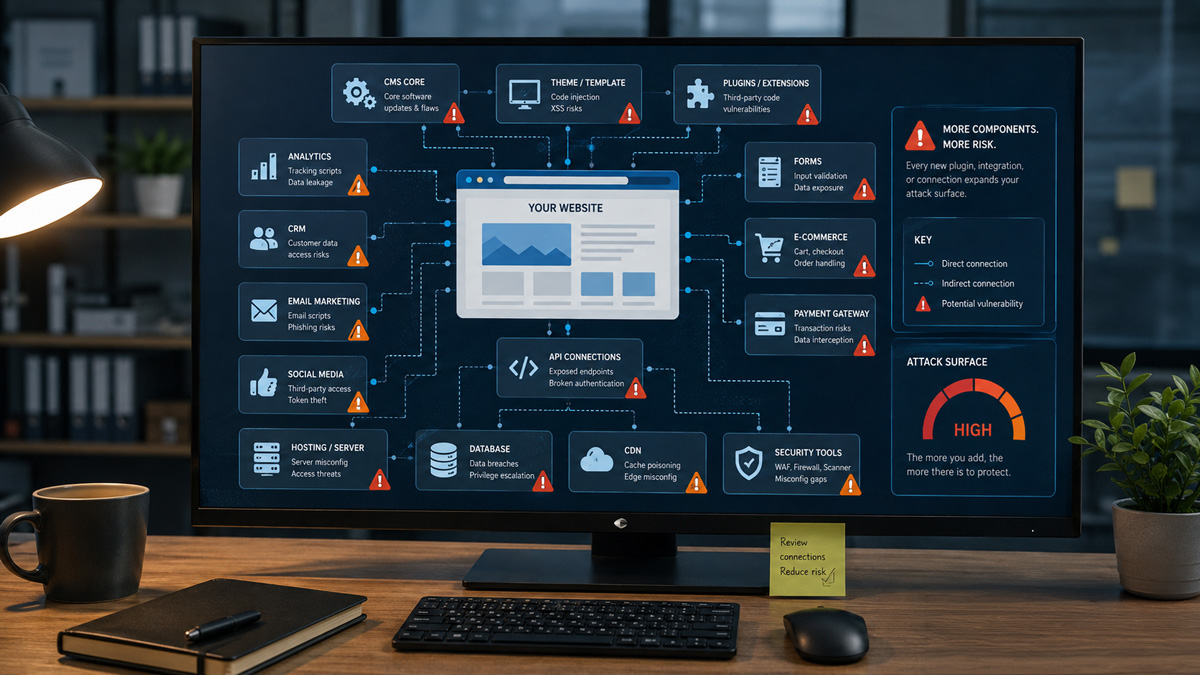
WordPress provides a useful example because of the enormous size of its ecosystem. Patchstack reported 11,334 new vulnerabilities in the WordPress ecosystem during 2025, a 42% increase from 2024. Of those vulnerabilities, 91% were found in plugins and 9% in themes. Only six were reported in WordPress core, and those were categorized as low priority.
This is why statements such as “WordPress isn’t secure” or “Joomla isn’t secure” oversimplify the issue. Website security depends on the entire environment: the CMS, extensions, plugins, templates, hosting, custom code, credentials, configuration, and third-party services.
Being Fully Updated Doesn’t Necessarily Mean You Aren’t Vulnerable
Keeping software updated is important, but if everything is updated, that does not automatically mean the website is secure.
A vulnerability can become known before the software developer has a fix available.
Patchstack reported that 46% of WordPress vulnerabilities disclosed in 2025 did not receive a developer fix in time for public disclosure.
That means a website can be running the latest available version of a plugin and still have a publicly known vulnerability because no newer version exists yet.
Software can also become abandoned. Plugins, extensions, templates, and other components that worked perfectly for years can stop receiving security updates because the developer discontinued the product or stopped maintaining it.
This is another reason web security is not a one-and-done task.
Websites Accumulate Security Risk Over Time
Websites tend to grow rather than get simpler.
A website that has been online for several years may have old administrator accounts, unused plugins, abandoned extensions, outdated integrations, old staging copies, or custom code written years ago.
The public-facing website may look almost identical to the way it looked three years ago while the software environment underneath it has changed substantially.
Meanwhile, new vulnerabilities are discovered, attack techniques evolve, software becomes unsupported, and security standards change.
A website that was properly secured when it launched is not properly secured today.
Hosting Security and Website Security Are Not the Same Thing
Another common misunderstanding is assuming that the web hosting company is handling all of this.
A reputable hosting provider should secure the portions of the infrastructure it is responsible for. That may include servers, networks, operating systems, and other hosting-level protections.
But that does not necessarily mean the hosting company is actively managing the security of your particular website.
The web host is not typically responsible for monitoring your CMS, plugins, extensions, custom code, application-level vulnerabilities, or other website-specific issues.
“Secure hosting” and “a securely maintained website” are related, but they are not interchangeable.
Your Original Web Designer May Not Be Maintaining Your Website Either
The same misunderstanding can occur with the person or company that originally designed the website.
Building a website and providing ongoing web security are two different services.
Unless you have a web security service in place, you should not assume the original developer is monitoring vulnerability disclosures, checking for malicious activity, managing updates, reviewing security alerts, or responding to newly discovered threats.
Even if you pay for ongoing website maintenance, it is worth understanding exactly what that service includes. “Website maintenance” can mean very different things from one provider to another and may not include true web security.
Ultimately, every website owner should be able to answer a simple question: Who is responsible for the security of this website right now and what are they proactively doing?
Website Security in 2026 Requires Ongoing Expertise
There is no single plugin, firewall, hosting company, update schedule, or security product that makes a website permanently secure.
Effective website security involves multiple layers and an ongoing process. The appropriate approach varies based on the CMS, hosting environment, software being used, functionality of the site, business risk, and other factors.
That is also why I don’t recommend treating an article like this as a master checklist and attempting to implement every security tool you can find.
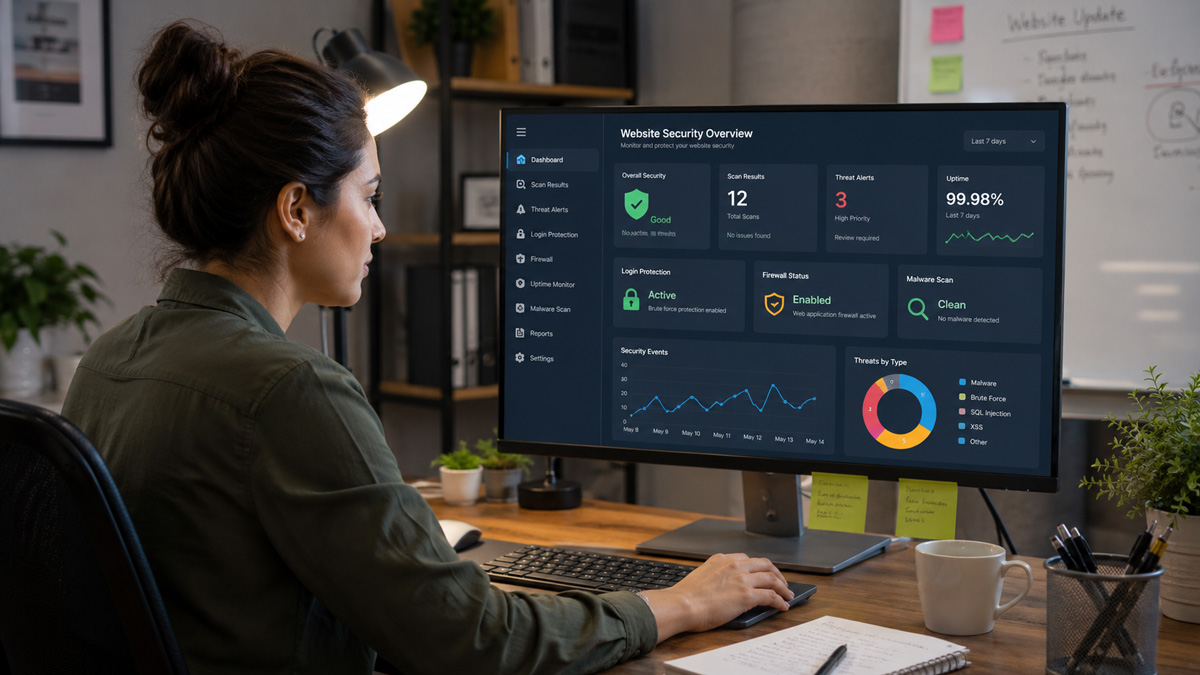
Instead, work with a qualified web security professional who can evaluate your specific website, identify the risks that actually apply to it, and develop appropriate policies and processes for monitoring, patching, access control, application security, backups, firewalls, malware detection, incident response, and other protections where appropriate.
No qualified professional can promise that your website will never be attacked or hacked. The goal is to reduce your risk, make successful attacks more difficult, identify problems quickly, and have a plan for responding when something does go wrong.
If your website seems like it is being attacked more frequently in 2026, you are not imagining it. The tools available to attackers are improving, vulnerabilities are being exploited faster, and websites themselves are increasingly complex.
The question is no longer whether someone is actively trying to target your business. The better question is whether someone qualified is actively protecting your website.
Need a Recommendation for a Qualified Developer Who Offers Web Security?
If you’re satisfied with your current web developer, you should simply talk to your existing web development firm to better understand what they are doing for web security.
If you have concerns that they may not be addressing your web security or web security has fallen on your shoulders in-house, feel free to reach out to us for some additional guidance. While we do not offer web security services without other service engagements, we can certainly point you to someone we trust who can help as well as provide some additional information on useful tools.
Also, we’d encourage you to sign up for our free newsletter where we share more useful information with our subscribers on a monthly basis.