How Long Does It Take to See Results from SEO?
“How long does SEO take to work?” is one of the most common questions we hear when talking with small businesses about search engine optimization (SEO) services. It also comes up frequently when we teach seminars to small businesses and other marketing professionals about search engine optimization.
It’s a fair and excellent question to be asking.
When a small business invests time, money, and energy into SEO, they want to know when that investment will start paying off. Unfortunately, the honest answer is not as simple as “right away” or “within a month.” SEO timelines vary based on your competition density, your current website, your industry, your location, your existing online authority, how much work needs to be done, and honestly, who is actually performing the search engine optimization.
That said, a good general rule of thumb is this:
Plan to re-evaluate your SEO progress after about six months. You should be seeing results by then.

That does not mean you won’t see some SEO progress before six months. In some cases, businesses may see movement much sooner. However, six months is usually a reasonable point to determine whether your SEO efforts are creating measurable progress and whether it makes sense to continue investing to build on that momentum.
If you want to dive deeper into why we determined 6 months is a great evaluation point for your SEO progress, keep reading!
Table of Contents
- SEO Is Not a Set-It-and-Forget-It Strategy
- SEO Progress Has Multiple Lag Effects
- What Counts as an SEO Result?
- You Must Track Rankings and Conversions
- SEO Progress Is Not Always Linear
- Six Months Is a Good Point to Re-Evaluate
- SEO Still Requires a Long-Term Mindset
- Red Flags When Evaluating SEO Progress
- Final Takeaway: SEO Takes Time, But It Should Show Progress
SEO Is Not a Set-It-and-Forget-It Strategy
One of the biggest misconceptions about SEO is that it is something you “do once.”
You optimize a few pages, create content, optimize profiles, and then move on.
That’s not how effective SEO works.
Search engine optimization is an ongoing process. Your competitors are changing. Google is changing. Search behavior is changing. Your website may need new content, better internal linking, technical improvements, stronger local signals, new reviews, updated service pages, or improved conversion tracking.
And all of that can change with a simple Google algorithm update.
If you handle SEO in-house, the timeline will depend heavily on your available tools, your team’s experience, and how consistently the work gets done. A business owner or internal marketing person may absolutely be capable of making some SEO progress, but SEO requires both strategy and follow-through.
If you hire an agency, quality can vary significantly. Some agencies have deep SEO expertise. Others treat SEO as an add-on or afterthought to their other services, like web design. That matters because SEO is not just about checking boxes. It requires knowing which issues are worth prioritizing, how to implement changes correctly, and how to measure whether those changes are actually helping the business. If you are unsure if the agency you picked for SEO is actually talented, you might take a look at our what to look for when hiring an SEO company guide.
SEO Progress Has Multiple Lag Effects
SEO has what I often describe as a “lag effect.”
In other words, the work you do today may not show its full impact tomorrow, next week, or even next month.
There are a few reasons for this.
Internal Lag Effects
First, SEO initiatives take time to identify, plan, approve, and implement. For example, your business may need technical fixes, new service pages, revised website copy, local SEO improvements, Google Business Profile optimization, internal linking updates, or content strategy work. Each of those initiatives typically require time to identify the issue, plan how to best fix and prioritize the issue, get the client’s sign-off, and finally implement.
All of that is done offline until the implementation step, which means Google hasn’t yet seen all of your hard work.
Google Lag Effects
Once changes are actually implemented, search engines still need time to crawl, process, understand, and evaluate those changes.
Additionally, Google does not reward every improvement instantly. Even if you make the right changes, it can take time for those improvements to influence rankings, visibility, traffic, and conversions.
The lag effects of SEO is one of the reasons SEO can feel frustrating in the early stages. You may be doing the right work months before the results are fully visible.
What Counts as an SEO Result?
Before evaluating how long SEO takes, it’s important to define what a “result” actually means.
For many small businesses, SEO results should not be measured only by whether you rank number one for a specific keyword. Rankings matter, but they are only one piece of the picture.
You need to define your own metrics of success, but generally “SEO progress” may include:
- Improved rankings for important keywords in traditional search engines
- Inclusion in AI/LLM recommendations for your target queries
- Better visibility in Google Maps and local search results
- Increased organic website traffic
- Increased calls from qualified leads
- Increased quality contact form submissions
- Increased appointment bookings
- Increased quote requests
- Increased online transactions
- Improved quality of incoming leads
For local businesses especially, the real goal is not just visibility. The goal is visibility that turns into meaningful business opportunities and direct impact on Revenue.
That is why tracking both rankings and conversions is so important.
You Must Track Rankings and Conversions
If you are investing in SEO, you need to know what is happening.
Some agencies provide rank tracking, reporting, and conversion tracking as part of their services. If they do, make sure you actually look at those reports routinely and understand what they mean.
If your agency does not provide this type of tracking, or if you are handling SEO internally, tools can help. For local rank tracking, we often recommend BrightLocal because it allows businesses to monitor rankings in specific geographic areas. That is especially helpful for local businesses and multi-location businesses because rankings can vary dramatically from one part of town (or zip code) to another.
For conversion tracking, WhatConverts can be useful because it helps track actions such as phone calls, form submissions, transactions, and appointment bookings.
Conversion tracking matters because rankings alone do not tell the whole story.
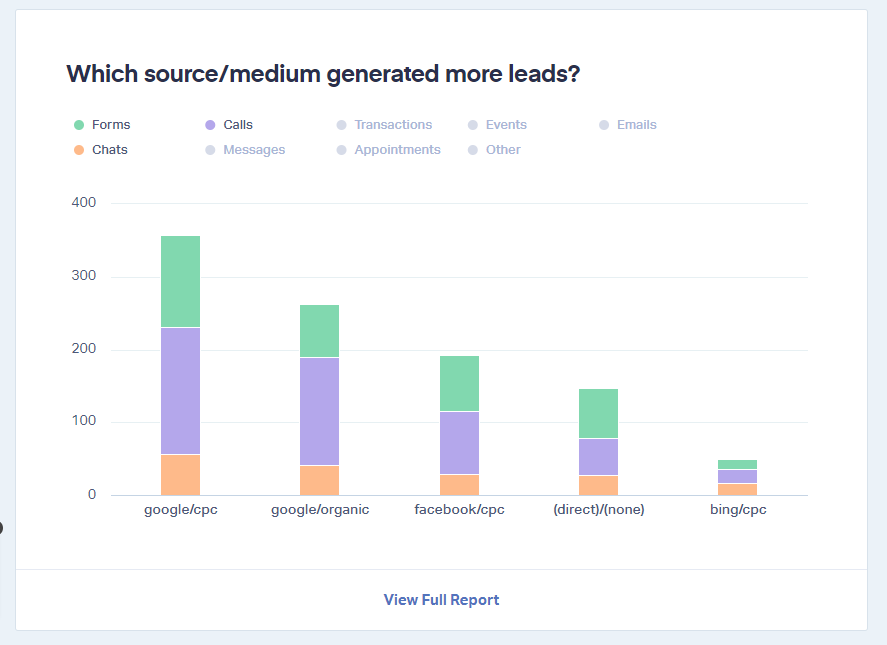
You could rank higher for a keyword that never produces leads. You could also see fewer visits but better qualified conversions. Without tracking, you are guessing.
SEO Progress Is Not Always Linear
Another important expectation to set is that SEO progress is not always a straight line upward.
Rankings fluctuate. Competitors make changes. Google updates its systems and rolls out new AI features. Search results shift. Local map packs can vary based on proximity, search wording, user behavior, and other factors.
Because of that, a good SEO report should show both positive and negative movement.

That may sound strange at first. After all, who wants to see rankings drop?
Honest Reporting Should Reflect Volatile Reality
If you only ever see positive movement in your SEO reports, you are likely seeing only part of the picture at best. At worst, the report may be selectively filtered or doctored to make performance look better than it really is.
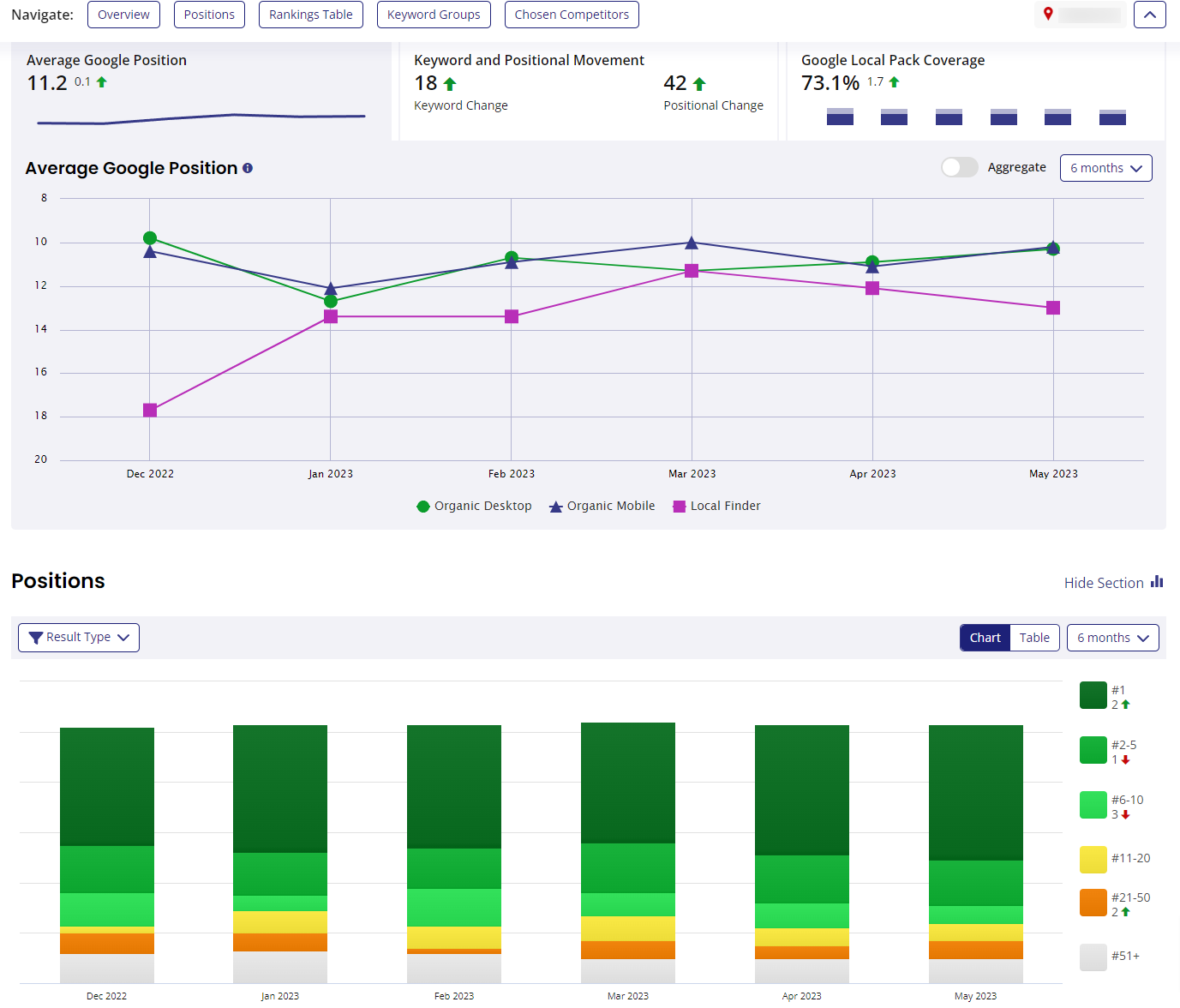
SEO should be evaluated by trends, not isolated data points. A single ranking drop does not necessarily mean the strategy is failing. A single ranking increase does not necessarily mean the strategy is working. The more important question is whether your visibility, traffic, and conversions are moving in the right direction over time.
Early SEO Wins Can Happen
While SEO often takes time, early wins are possible.
This is especially true when a business is competing in a hyperlocal market or when there is a major issue holding the website back.
For example, we once worked with an accounting company whose website had been accidentally noindexed by their web designer (not us!), due to a toggle being set incorrectly within WordPress. In simple terms, that meant search engines were being told not to index important their entire site. When an issue like that is fixed, improvement can happen within days because the site was being held back by a significant technical problem.
We have also seen a home services company experience a quicker boost in visibility after its Google Business Profile was properly optimized, especially with categories and services selection. For local businesses, an incomplete or poorly optimized Google Business Profile can limit visibility in Google Maps and local search results.

Addressing those issues can sometimes create noticeable movement sooner than broader organic SEO work.
However, early wins should not be confused with the full payoff of SEO.
Quick improvements are great, but sustainable SEO growth usually requires ongoing work.
Six Months Is a Good Point to Re-Evaluate
Because of the lag effect, six months is often a good point to evaluate your SEO investment.
At that stage, you should be asking questions such as:
- Are rankings improving for meaningful search terms?
- Is local visibility getting stronger?
- Are more people finding the business through organic search?
- Are quality calls, forms, bookings, or transactions increasing?
- Is the strategy becoming more refined based on data?
- Does continued investment make sense based on the progress so far?
This does not mean every SEO campaign will produce dramatic results in six months. Some websites need extensive repair before growth is realistic. Highly competitive industries require a longer runway.
However, after six months, you should usually be able to see whether there is movement, whether the strategy is sound, and whether the work being performed is worth continuing.
SEO Still Requires a Long-Term Mindset
Even though six months is a good evaluation point, SEO should still be approached with a long-term mindset.
The reason is simple: SEO compounds.
Strong content, better website structure, improved local visibility, more reviews, stronger authority, and better conversion tracking can continue to build on one another over time. Once momentum develops, ongoing SEO helps protect and expand that progress.
The mistake is thinking of SEO as a short-term campaign instead of an ongoing part of your marketing foundation.
That said, a long-term mindset does not mean you should blindly commit to a long-term contract.
Be Careful with Long SEO Contracts
Because SEO takes time, many agencies require long contracts. Six-month, one-year, and even two-year SEO agreements are common in the industry. We’ve seen them all.
I understand why agencies do this. SEO takes sustained effort, and results usually do not happen overnight.
However, from a small business perspective, long contracts can create risk. If the agency is not communicating well, not implementing meaningful work, not tracking conversions, or not communicating progress, you may be stuck paying for months of services that are not helping your business.
As a small business, you might have a huge, unexpected expense occur that derails your budget. For example, due to an odd scenario one of our clients had to unexpectantly replace expensive medical equipment, that should have lasted another 7+ years of life. With a month-to-month contract, they could hit pause on their SEO, which is what we recommend.
At Igniting Business, we work with small businesses, and we only offer SEO services on a month-to-month basis. We believe that is in the best interest of the small business.
That does not mean SEO should be treated casually or stopped after one slow month. It simply means a small business should not have to be locked into a long contract to receive quality SEO help.
Red Flags When Evaluating SEO Progress
As you evaluate your SEO efforts, watch for warning signs.
One major red flag is guaranteed rankings. No SEO company can honestly guarantee a specific ranking on Google. There are too many variables outside of any one agency’s control.
Another red flag is reporting that only focuses on good news. As mentioned earlier, rankings naturally fluctuate. If your reports only show increases, you may not be getting a complete picture.
Other red flags include vague reporting, no conversion tracking offered (keep in mind this is more expensive to implement), no explanation of the work being completed, no clear strategy, or an overemphasis on rankings without connecting those rankings to business outcomes.
SEO should not feel like a mystery where your SEO expert provides services behind his magic curtain. Your SEO partner should be able to explain what they are doing, why they are doing it, and how progress is being measured.
If you are trying to choose the right SEO partner, we cover this topic in more detail in our guide on What to Look for When Hiring an SEO Company.
Final Takeaway: SEO Takes Time, But It Should Show Progress
So, how long does it take to see results from SEO?
The honest answer is that it varies. Competition, location, website quality, technical issues, content, reviews, authority, and implementation speed all affect the timeline.
However, as a general rule of thumb, six months is a smart point to re-evaluate your SEO efforts.
By then, you should have enough data to determine whether progress is happening, whether the strategy makes sense, and whether it is worth continuing to invest.
SEO is not instant. It is not guaranteed. It is not set-it-and-forget-it.
But when done correctly, tracked honestly, and approached with a long-term mindset, SEO can become one of the most cost-effective marketing investments a small business makes.
If you’d like to receive more SEO tips like this, feel free to subscribe to our free monthly newsletter or take a look at the best SEO newsletters from SEO experts smarter than us!
At no additional cost to you, we may receive a commission if you click on some of the links on this website and make a purchase.